Self-hosted · local + cloud models · one governor
AOS is a self-hosted agentic AI service in miniature — the stack the frontier providers run internally, scaled to your hardware. It routes work across local and cloud models, bounds what every agent may spend, proves whether it did the work it claims, and rolls back what it didn't.
Runs on a laptop. No cloud dependency. Your keys, your models, your ledger. ·
$ aos run "fix the failing test" --budget 2.00 reserve $2.00 leased · balance $23.42 route standard → qwen3-coder:30b (local, $0) checkpoint worktree aos/run_8f2c — checkout untouched run 4 tool calls · 2 files changed verify npm test ✓ 41 passed · judge ✓ grounded settle true cost $0.0000 · work merged ✓ settled trust(fix-tests, qwen3) → 7 consecutive passes
Why AOS exists
Every run is verified against evidence AOS watched it produce — your build, your tests, and an independent fresh-context judge. "Looks done" is not a verdict.
Every run leases a hard budget before the first token, and settles its true cost to an append-only ledger. No lease, no run. No surprise invoice, ever.
Models and tools are interchangeable capabilities.
Governance is the durable asset.
What's in the box
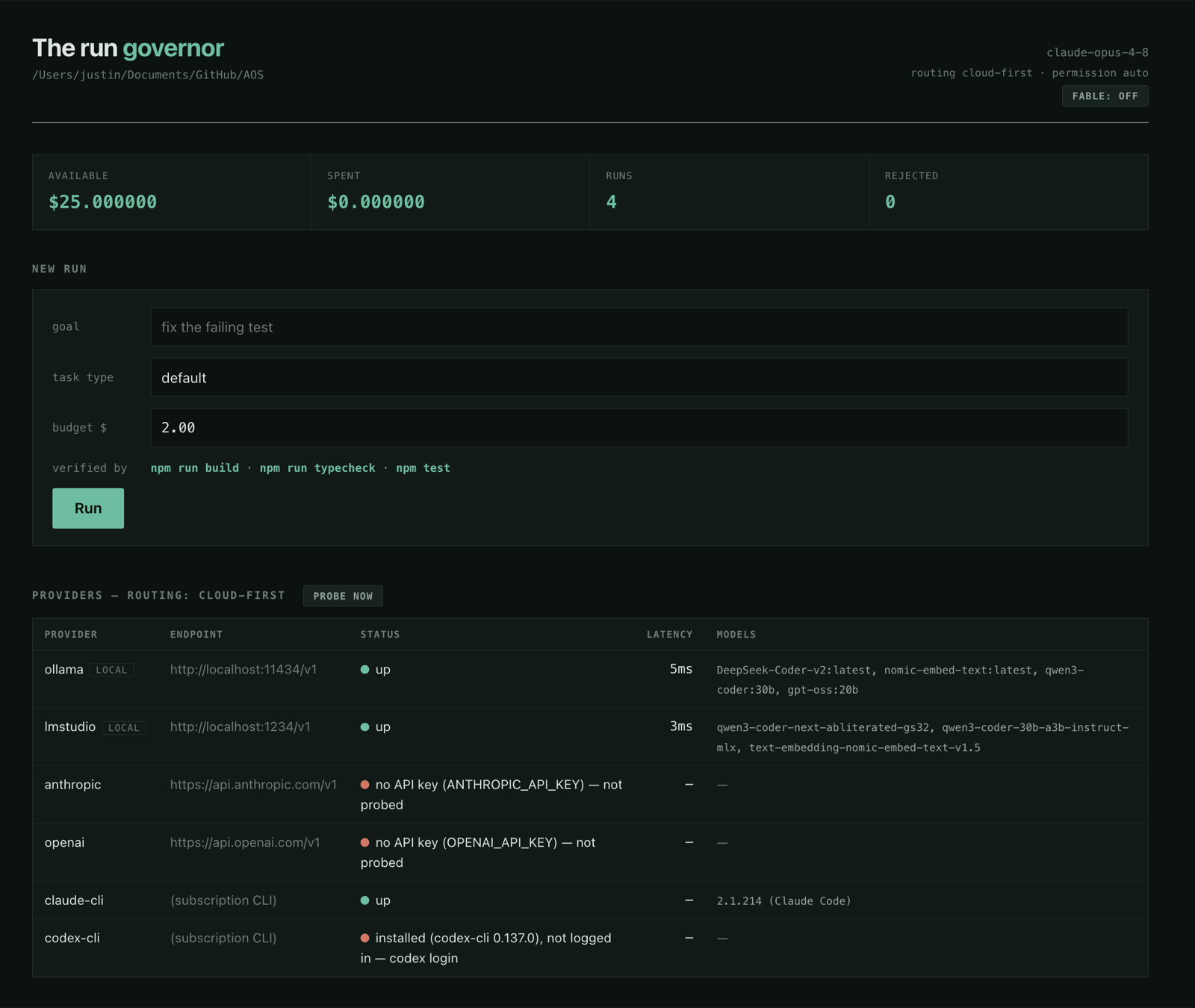
Local models (Ollama, LM Studio, vLLM) for routine work; Claude and OpenAI for the hard problems. Complexity, blast radius, and novelty decide the tier — and every routing decision is recorded and queryable.
Deterministic checks (your build, your tests), a sentinel watching every artifact, and a fresh-context model judge. A run passes on evidence, not on the agent's self-report.
Runs lease money before they start and settle their true cost after. Budgets cascade to sub-agents and retries by construction — spending stops when the money does.
Each run executes in its own isolated git worktree. Rejected work is discarded entirely; verified work merges back. Your checkout is untouchable — always.
Autonomy is accrued, not assumed. Consecutive verified passes per task-type-and-model pair unlock longer leashes; failures revoke them. The trust ledger is the receipt.
Works on a plane: local-only routing that fails closed. In offline mode, nothing opens a socket to a cloud provider — guaranteed by the runtime, not by a config suggestion.
Viewer, approver, operator, admin. Dangerous actions park on a human before they execute; every ledger entry records who launched the run. Break-glass admin included.
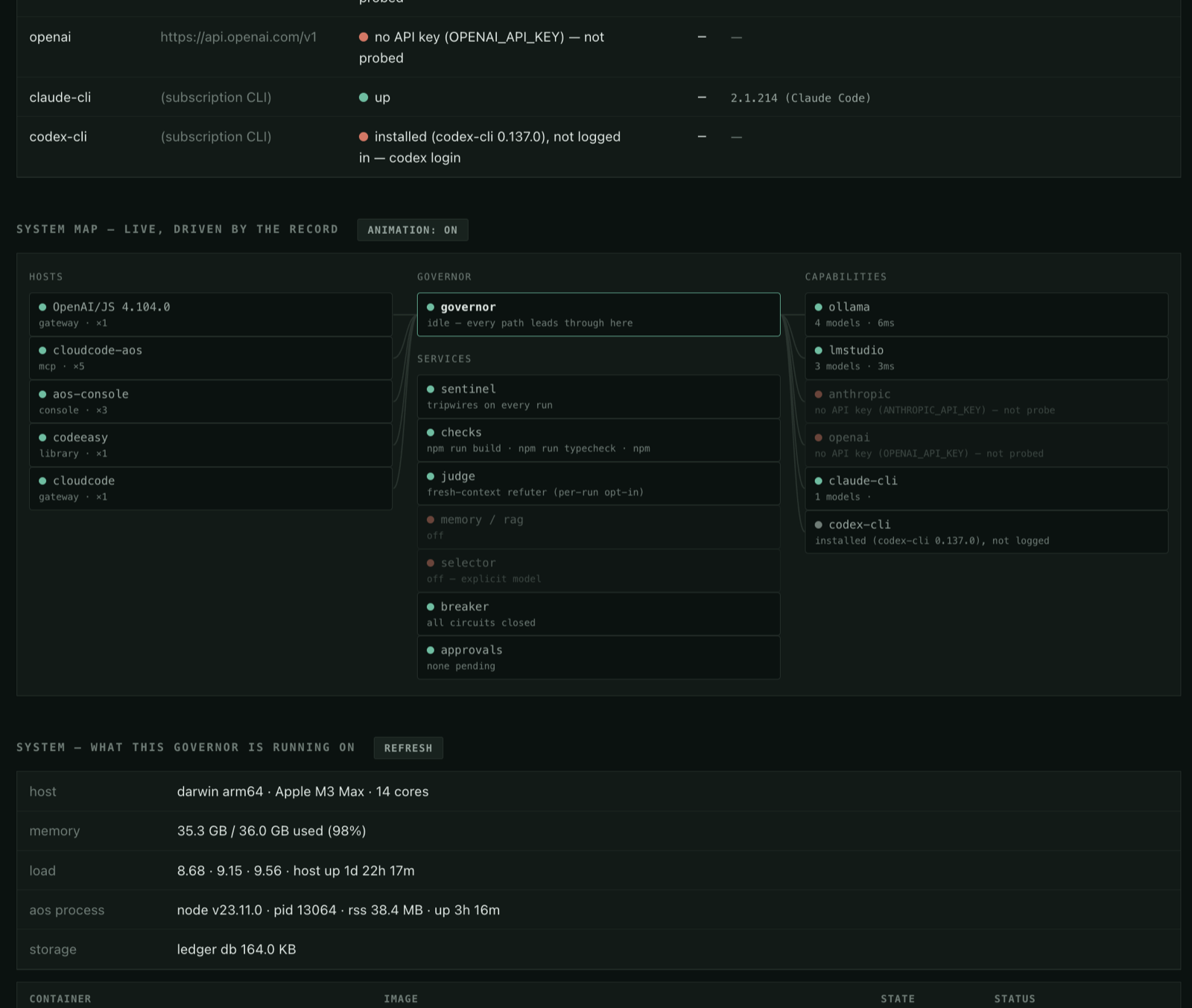
A live console with an animated system map, provider health probes, per-run traces, Prometheus metrics, and one-screen diagnostics. Nothing phones home — telemetry is local-only, structurally.
How it works
AOS scores the goal, picks the cheapest model that can carry it, applies permission and risk policy, leases a hard budget, and checkpoints the workspace. A run that can't be verified or can't be afforded is refused up front — the cheapest failure is the one that never starts.
The work is checked against your toolchain and judged by a model that never saw the agent's reasoning. Pass → merge, settle the true cost, add a trust point. Fail → roll it all back, settle what was actually burned, record why. Either way: an auditable entry, forever.
The call flow
Cloud Code, Code Easy, or any OpenAI-compatible tool makes the call — AOS decides where it runs. Routine work never leaves your hardware. Hard work is escalated, deliberately, with the reason on the record.
Production integrity
AOS is built under a standing adversarial audit: independent reviewer passes over the money path, the wiring, and every API door — reporting only defects demonstrable from executable code. 618 automated tests gate every push, and every invariant below is verified against the code, not the documentation.
Integrations
aos run · CLIThe terminal front door: governed runs, budgets, trust, and a one-screen
aos doctor. Five minutes from install to a verified run via
aos setup.
aos serve · ConsoleThe web console: launch and watch runs, approve dangerous actions, probe provider health, and see every host that's connected — live.
aos gateway · OpenAI-compatible APIPoint any OpenAI-style client at /v1/chat/completions and every call
becomes governed, metered inference. Existing tools keep working; the ledger starts.
aos mcp · MCPConnect Claude Desktop — or any MCP client — and drive governed runs from chat, with approvals elicited in-conversation. Also a TypeScript library for embedding.
No API key? AOS can route through the Claude or Codex CLI on your own subscription — governed, metered, and budget-bounded like everything else.
Companion products
AOS governs any agent through its four doors — and two products already speak it natively.
A terminal-native coding agent with local and cloud models, permission gates, and MCP. Point it at AOS and every session becomes governed: connect over MCP to launch verified, budgeted runs from chat, or route its models through the AOS gateway for metered, ledgered inference.
Compatible with Cloud Code 1.3.0 and higher — MCP and gateway integration built in.
Spec-driven autonomous development: capture a spec, let a multi-agent build loop implement and validate it. With AOS enabled, every work item runs under the governor — hard budgets, mid-run stops, real toolchain verification, and rollback when the work doesn't hold up.
Compatible with Code Easy 2.0.0 and higher — AOS governance selectable from the dashboard, API, or MCP.
Not using either? Anything that speaks OpenAI's API or MCP — or embeds a TypeScript library — plugs into the same governor.
Where it fits
Run coding agents overnight with a hard dollar ceiling and wake up to verified work — or a clean rollback and a receipt for exactly what was attempted. Local models keep the routine work free.
One governor for the whole team: per-user attribution, role-gated launches, human approval on dangerous actions, and a shared ledger that ends the "what did the AI spend this month?" mystery.
A private, self-hosted agent service across your own machines — local GPU boxes for the work, cloud only when a problem earns it, and a fully-offline mode that fails closed.
Ship agentic features without shipping unbounded spend. Embed AOS as a library, or put the gateway in front of your existing runner — your product gets budgets, verification, and rollback for free.
Editions
Free
Per seat
Let's talk
AOS never marks up your tokens. You bring your own keys and subscriptions; the product is the governance.
AOS is in private beta — v1.0.0-beta. Tell us what your agents run, and we'll get you a build and five minutes to your first governed run.
Request beta accessSelf-hosted · your keys stay yours · nothing phones home